

ENGINEERED · COORDINATED · EXECUTED
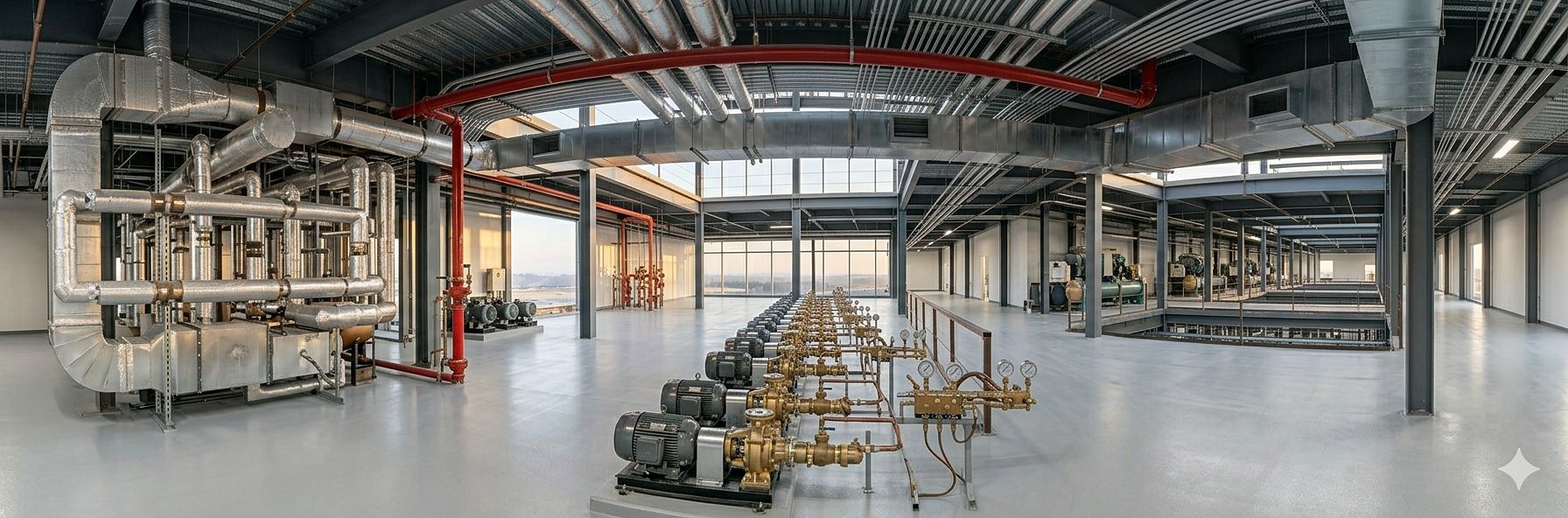
HVAC, industrial ventilation, process cooling, process piping, compressed air and boilers — designed by mechanical engineers, supplied by procurement that knows the market, installed by crews who do this for a living.
Mechanical is the discipline that decides whether a facility actually works on day one — and whether it keeps working after.
Most operational problems on an industrial site are mechanical in origin — HVAC that can't hold pressure cascade, chiller plants that short-cycle, process piping that vibrates because supports were value-engineered out. We engineer to avoid the failure modes we've seen across pharma, automotive, FMCG and petrochemical projects — and install them ourselves so design intent matches what's on site.
The full mechanical scope is available as part of a turnkey MEPF EPC contract, or as a single-discipline mechanical EPC where the rest of the project is awarded separately.
What a typical mechanical EPC scope covers
Each sub-system is engineered and installed by the same team that owns the rest of the mechanical contract — so the integration points are decided once, by people who will be the ones connecting them on site.
Chiller plants, AHUs, FCUs, VRF systems, terminal HEPA filtration, pressure-cascade design for pharma cleanrooms and operating theatres.
Process exhaust, fume extraction, dust collection, kitchen ventilation, smoke management designed to NBC and NFPA 92.
Cooling towers, plate heat exchangers, glycol loops, chilled water distribution, process water for utilities and manufacturing.
Carbon steel, stainless 304/316, alloy and lined piping for utilities, process and clean media — fabricated, hydrotested, NDT-validated to ASME B31.3.
Compressor rooms, dryers, receivers, ring-mains, point-of-use regulation, oil-free systems where pharma or food contact requires it.
Boiler installation, steam distribution, condensate recovery, heat exchangers — engineered for the duty cycle, not just the nameplate load.
Mechanical work is governed by a layered stack of standards. We don't tick the box — we design and document compliance from the first load calculation through to the final commissioning report.
National Building Code is the baseline for all HVAC and ventilation work in India. Section 8 (Building Services) is where MEPF compliance lives.
Industry-standard HVAC design practice — load calculations, cleanroom protocols, energy efficiency targets.
Process piping (B31.3) and power piping (B31.1) — fabrication, welding qualification, hydrotesting, NDT.
Smoke management systems for atria, large enclosures and high-rise buildings — design and commissioning protocols.
IS 7613, IS 277, IS 4894 and others — materials, ducting, refrigerant piping practice for the Indian market.
For pharma cleanroom HVAC — validation-ready design with documented airflow visualisation, smoke studies and IQ/OQ support.
The mechanical scope changes character significantly by sector. Pharma is about pressure cascades and validation. Automotive is about availability and dust extraction. Hospitals are about infection control. We design for the sector, not the nameplate.
Centralised air conditioning and VRV/VRF systems, AHU and industrial ventilation, chilled water and process cooling, process piping to ASME B31.3, compressed air, steam, hot oil and PNG/LPG/HSD fuel piping — engineered, supplied, installed and commissioned by one team.
Yes. Our mechanical team engineers and executes process piping to ASME B31.3 (process piping) for pharmaceutical, chemical, petrochemical and food-processing projects — with stress analysis, hydrotesting and radiographic inspection where the service condition requires it.
Yes. We deliver validated cleanroom HVAC with classified pressure cascades, HEPA filtration, USFDA / WHO cGMP-ready documentation, smoke studies and IQ/OQ support for pharma, biotech and electronics manufacturing projects.
Send the brief — we'll respond with the right team, not a sales pitch. One conversation with engineers who will actually run the project.
We respond personally, within one working day.