

ENGINEERED · COORDINATED · EXECUTED
Sprinklers, hydrants, fire pumps, detection & alarm, gas suppression and foam systems — designed to NFPA, NBC and TAC, with FM Global compliance where the insurer requires it.
Fire protection is the discipline that gets audited hardest, by the most parties — Chief Fire Officer, TAC inspector, your insurer, the local fire authority and (for export-grade facilities) FM Global.
We design fire protection to pass each audit the first time — hydraulic calculations that survive room-by-room scrutiny, sprinkler density matched to occupancy hazard class, NFPA 20 pump curve documentation and alarm logic the AHJ recognises. Not exotic — just done properly, by people who've done it before.
For high-hazard occupancies and protected risks, scope extends to clean-agent gas suppression (FM-200, Novec 1230, Inergen) and foam systems for petrochemical applications.
What a typical fire EPC scope covers
Fire protection isn't just sprinklers. It's a coordinated stack of detection, suppression, smoke management and evacuation — designed so each system actuates the others correctly under a real event.
Wet, dry, pre-action, deluge — designed to NFPA 13 occupancy hazard class with hydraulic calculations to size mains, branch lines and the demand on the pump room.
Internal and external hydrants, landing valves, hose reels — NFPA 14 distribution with appropriate pressure-zoning.
Electric main pump, diesel standby pump, jockey pump, manifold, controllers — assembled and tested as a code-compliant unit, not an assortment of components.
Addressable detection — smoke, heat, flame and beam — interfaced with voice evacuation and BMS, fully zoned for the AHJ's life-safety strategy.
FM-200, Novec 1230, Inergen and CO₂ for server rooms, electrical rooms, archive vaults — with concentration calculations and discharge-time validation.
Aspirated foam for petrochemical and warehouse-storage occupancies, kitchen hood ANSUL R-102, water mist for specific protected risks.
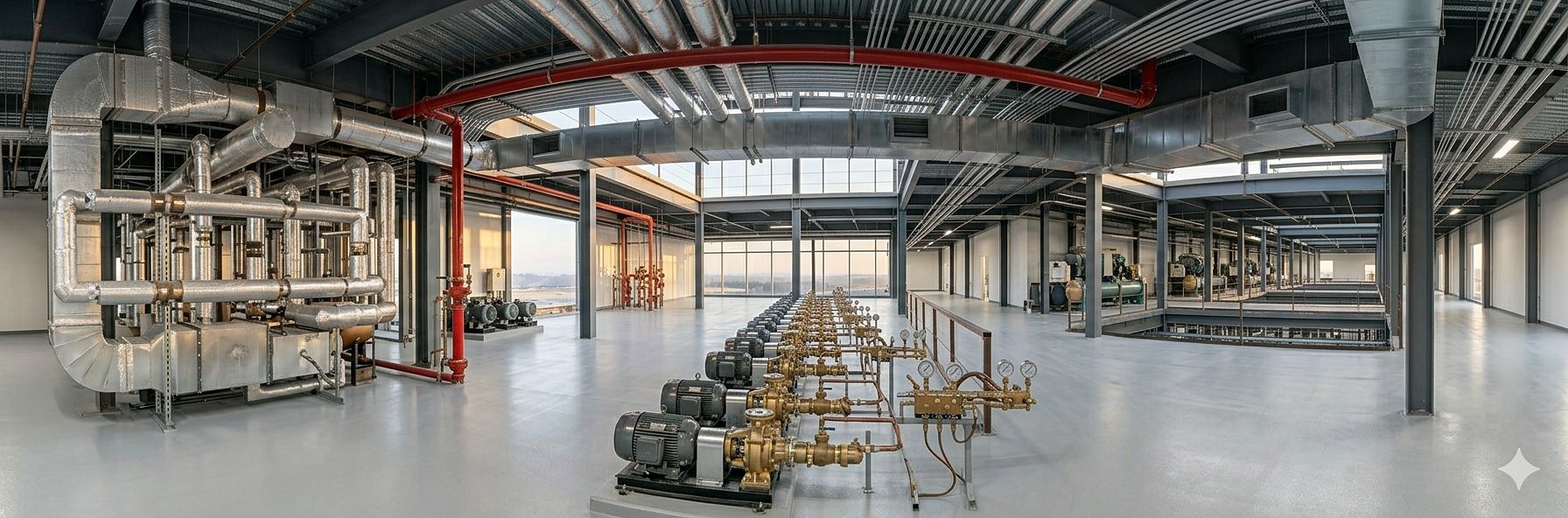
Fire protection is the most standards-driven discipline on the MEPF stack. We design and document to the layered code framework that your AHJ and insurer will check.
The reference standard for sprinkler system design — occupancy hazard classifications, density curves, hydraulic calculations.
Standpipe / hose systems (14) and fire pump installation (20) — the water-supply backbone of the protected facility.
Fire alarm and signalling systems — detection, notification, monitoring, off-premises signalling.
Indian National Building Code — fire and life safety chapter, the legally enforceable baseline in India.
Tariff Advisory Committee — the insurance-industry technical framework that drives premium calculations in India.
For export-grade facilities and insurer-driven projects — FM Global Data Sheets applied alongside NFPA and NBC.
Fire protection scope scales with occupancy hazard. A pharma cleanroom has clean-agent zones over electrical rooms; a warehouse needs ESFR sprinklers; a refinery needs foam. We engineer for the actual hazard, not the cheapest catalogue spec.
Send the brief — occupancy hazard class, AHJ jurisdiction, insurer requirements, building topology. We respond with the right team.
We respond personally, within one working day.